
Editorial Policies
The aim of the journal is to publish peer reviewed original research papers reporting on studies of the structure, algorithms, behavior, and interactions of natural, social, socio-technical, and artificial systems that store, process, access, and communicate information. It concerns data, information, and knowledge fundamentals, models, and management from the points of view of their discovery, engineering, and application.
The journal publishes four regular issues per year in the following areas:
Social, Socio-technical, Organization and Business Informatics, which includes but is not limited to
- Social Systems Informatics
- Socio-technical Systems Informatics
- Organization Informatics
- Business Informatics
- Natural Systems Informatics
- Artificial Systems Informatics
High Complexity Information Systems Engineering , which includes but is not limited to
- Intelligent Systems Engineering
- Complex Systems Modeling and Software Development
- Adaptive and Adaptable Information Systems Engineering
- Networked Systems Engineering
- Emergent and Virtual Systems Engineering
Data and Knowledge Analytics, which includes but is not limited to
- Data Intensive Computing
- Semantic Data Analysis and Management
- Big Data Analytics
- Knowledge Analytics
- Business Analytics
- Social Networks Analytics
Supercomputing, which includes but is not limited to
- High Performance Computing
- High Throughput Computing
- Grid Computing
- Cloud Computing
- Supercomputing for Engineering Applications
- Mathematical and Analytical Methods for Scientific Computing
- Supercomputing for Social Systems
Special issues can be published upon the request.
The main principles of the journal are the following:
- Usefulness and relevance of papers
- Comfort for authors and readers
- Flexibility in publishing
The review process is organized in the OJS as a single-blinded peer review performed by the External Reviewers and the members of the International Editorial Review Board. For each article, the minimum number of article reviewers is 2 (the average number of reviewers is 3). At least one External Reviewer participates in the review process of each article. For each issue, the review process is managed by the Issue Editor(s) in cooperation with the Area Editors and the Managing Editor. Each issue is submitted for approval to the Editor in Chief of the journal.
CSIMQ considers primary scientific articles and extended versions of papers selected by program committees of scientific events. The review process is initiated and supported by the Managing Editor of the journal. In the review process, the following rules are applied to different types of the articles:
Article type |
CSIMQ review process rules |
|---|---|
|
Primary research articles |
The article review process is managed by one of the CSIMQ Area Editors or assigned Issue Editor, and coordinated with the Editor in Chief. |
|
Extended versions of conference/symposium/workshop papers |
The article review process is managed by the Issue Editor(s) (usually the PC chair(s) of the respective scientific event), and coordinated with the Editor in Chief. The articles must comply to the following requirements:
|
|
Papers of the conference/symposium/workshop with full or a part of proceedings published in CSIMQ |
The papers can be considered for publication in CSIMQ upon the agreement with the Area Editors and the Editor in Chief. The paper review process is managed by the CSIMQ assigned Issue Editor(s) (e.g. the PC chairs of the respective scientific event), and coordinated with the Editor in Chief. The review process should conform to the CSIMQ main principles and quality requirements (see CSIMQ evaluation criteria). |
Simplified scheme of the article handling workflow
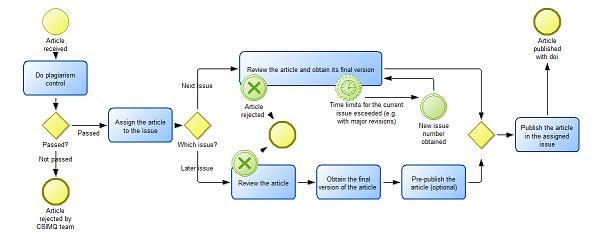
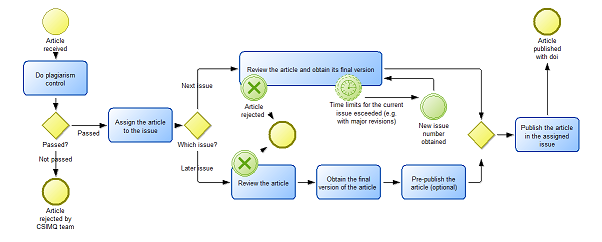
Each submission is checked for suitability when received by the editorial office, and may be rejected without reviewing if it is outside the scope of the journal, is obviously of insufficient quality, is missing important sections, the authors have not provided their institutional e-mails; or plagiarism is detected. The desk reject decisions are made by the Area Editors of CSIMQ.
Authors have an opportunity to indicate conflict of interest when submitting the article.
The accepted articles, on the request of the authors, can be pre-published on the Webpage of CSIMQ immediately after the technical editing of the article is finished.
Reviewers of CSIMQ follow the following criteria in evaluation:
1. Usefulness
2. Scientific Contribution
3. Practical Relevance
4. Clarity
5. Technical Quality (To provide as much comfort for authors as possible, formating is not considered here - the authors are free to choose the format of submission. The only requirements for formating are as follows: page format is A4, figures are well readable, references are fully described according to academic standards). Nevertheless, the formating guidelines and templates are provided and the journal team appreciates very much if the articles are submitted in CSIMQ format.
CSIMQ is published quarterly
- March/April
- June/July
- September/October
- December/January
This journal is published Open Access under a Creative Commons Attribution 4.0 International licence (CC BY 4.0) which allows readers to reuse the content without restriction. Readers are free to read, download, copy, distribute, print, search, or link to the full texts of its articles and to use them for any other lawful purpose. Open Access allows for unrestricted sharing of scholarly information and helps to promote knowledge throughout the world. RTU supports Open Access as an equitable means of ensuring that scholarly research, usually funded by public institutions, is made available to all. Open Access publications are more likely to be discovered, read, cited, and used for future research than those published in closed journals, and we believe it is in the best interests of authors and their parent institutions, as well as the journals themselves, to make all our content freely available and reusable.
Authors retain copyright in their articles, but grant RTU Press the right of the first publication.
Journal articles are deposited in the PKP Preservation Network (PN). The information about the journal's archival status can be found here https://portal.issn.org/resource/ISSN/2255-9922
Journal articles are deposited in the National Library of Latvia repository.
All CSIMQ content is screened for possible plagiarism using SimilarityCheck https://www.crossref.org/services/similarity-check/.
SimilarityCheck compares submitted manuscripts against a comprehensive large database of published technical papers (as well as over 6 billion Web pages), and provides a summary report that highlights the similarity to previously published work. The CSIMQ editorial team can then follow up to isolate and review the high-scoring papers as necessary.
Plagiarism detection systems are only as effective as the amount and quality of the source content within them. SimilarityCheck’s significant advantage over all other similar services is that it includes the indexed, full-text content of participating CrossCheck member publishers.
In case on high similarity percentage the author is contacted and the percentage is discussed. In the process of the discussion, COPE guidelines for handling plagiarism in a submitted article are followed https://publicationethics.org/resources/flowcharts/plagiarism-submitted-manuscript.
This journal is published Open Access under a Creative Commons Attribution 4.0 International licence (CC BY 4.0) which allows readers to reuse the content without restriction. Readers are free to read, download, copy, distribute, print, search, or link to the full texts of its articles and to use them for any other lawful purpose. Open Access allows for unrestricted sharing of scholarly information and helps to promote knowledge throughout the world. RTU supports Open Access as an equitable means of ensuring that scholarly research, usually funded by public institutions, is made available to all. Open Access publications are more likely to be discovered, read, cited, and used for future research than those published in closed journals, and we believe it is in the best interests of authors and their parent institutions, as well as the journals themselves, to make all our content freely available and reusable.
Published final versions of the articles are distributed via Abstracting and Indexing services of the journal.
Authors retain copyright in their articles, but grant RTU Press the right of the first publication
Download https://csimq-journals.rtu.lv/csimq/libraryFiles/downloadPublic/2
Authors who publish with CSIMQ agree to the following terms:
- The authors grant international journal "Complex Systems Informatics and Modeling Quarterly" (CSIMQ), currently published by RTU Press, the right of first publication of the Work, complying to Creative Commons Attribution License , as far as it is not stated differently in this Form, that allows others to share the Work with an acknowledgement of the Work's authorship and initial publication in CSIMQ. With this the authors also grant to the publisher of CSIMQ the following rights: to print the Work; to publish the Work; to distribute the Work; to make the Work available to the public by wire or by other means, in an individually selected location and at an individually selected time; to rent or to publicly lend copies of the Work; to translate the Work; and to use the Work in other ways permitted by the normative acts.
- The authors warrant that the Work submitted to CSIMQ is original, there is no third party that holds copyright to the Work (or the copyright transfer from this party is attached to this Form), and any excerpts from any other copyrighted material are included in the Work only with the permission of their copyright holders.
- The authors are able to enter into separate, additional contractual arrangements for the non-exclusive distribution of the published Work (e.g., post it to an institutional repository, website, or publish it in a book) with an acknowledgement of its initial publication in the international journal "Complex Systems Informatics and Modeling Quarterly" (CSIMQ), as it can lead to productive exchanges, as well as to greater citation of the Work.
- The authors certify that they bear the responsibility for any damage or expenses that may arise for RTU in the event of breach of these license agreement terms.
- The journal allows the author(s) to hold the copyright without restrictions.
When a researcher, author, editor, or reviewer has a financial or personal interest or belief that could affect his/her objectivity, or inappropriately influence his/her actions, a potential conflict of interest exists. Such relationships are also known as dual commitments, competing interests, or competing loyalties. Anything that could interfere with full and objective peer review, editorial decision making, or publication of research submitted to the journal is defined as conflict of interest.
Having a conflict of interest is not in itself unethical, and there are some that are unavoidable. Therefore, authors, reviewers and editors related to the submitted article should assess possible financial and non-financial interests that could influence objectivity of their report, unbiased work with the manuscript or its reviewing, the decision on publishing, and if in doubt, declare the respective conflicts of interest.
The authors have an opportunity to declare their conflicts of interest when submitting the article. Reviewers can declare their conflicts of interest to the issue editor(s).
These suggestions and requirements comply with RTU Press Policy on Declaration of Conflict of Interest available here.
CSIMQ is an Open Access journal with a business model that is based on the principle whereby the journal’s publication expenses are borne by the Riga Technical University.
The journal does not collect any Article Processing Charges (APC) for manuscript processing, editing, publishing and archiving. There are no fees associated with article downloads.
The aim of RTU Press is to ensure that the parties involved in the publishing process adhere to RTU Press Publication Ethics Guidelines and, if relevant, declare conflict of interest.
RTU Press Publication Ethics Guidelines are based on adherence to ethical principles set out in “Latvian Council of Science Code of Researcher’s Ethics “, “RTU Code of Ethics of Students and Personnel” and in Codes of Conduct and Best Practice Guidelines of Committee of Publication Ethics (COPE).
RTU Press Publication Ethics Guidelines set out the duties and responsibilities of editors, reviewers, authors and RTU Press and set out the process of dealing with cases of unethical behaviour or undisclosed conflicts of interest.
RTU Press Publication Ethics Guidelines are approved and monitored by RTU Ethics Committee (nominated by the Rector of RTU) which provides consultancy and investigates the cases compromising intellectual and ethical standards as well as takes the decisions in accordance with the principles set out in the legal acts of the Republic of Latvia.
1. Duties and responsibilities of Editor-in-Chief of a scientific journal
1.1. Editor-in-Chief ensures that
1.1.1. the journal has clearly defined principles of publishing ethics: the requirements regarding authorship, reviewing process, ethical guidelines, principles of disclosure of conflict of interest;
1.1.2. information on principles of publication ethics is accessible for authors and reviewers;
1.1.3. editors do not allow cases of plagiarism, self-plagiarism, redundant publication and “salami slicing” and see to the authorship issue of papers;
1.1.4. authors, editors and reviewers adhere to the principles of publishing ethics and norms set out in “Latvian Council of Science Code of Researchers’ Ethics”, “RTU Code of Ethics of Students and Personnel” and in Codes of Conduct and Best Practice Guidelines of Committee of Publication Ethics (COPE);
1.1.5. authors, editors and reviewers declare conflict of interest.
1.2. Editor-in-Chief should make honest and objective decisions.
The evaluation of manuscript and the decision on publishing should not be biased and influenced by personal reasons (professional, political, ideological, etc.). Possible financial and non-financial conflict of interest
should be assessed and the editor should abstain from the evaluation of the manuscript.
1.3. Editor-in-Chief has the authority to reject a manuscript on grounds of the declared conflict of interest of author, reviewer, or in case the manuscript does not adhere to the of RTU Press Guidelines of Publication Ethics.
1.4. If the Editorial Board of a journal receives a complaint about ethical misconduct the Editor-in-Chief should follow the procedures set out in the RTU Press Guidelines of Publication Ethics and investigate the complaints even if the manuscript has been accepted for publication. Editor-in-Chief should keep all documentation related to the complaints.
1.5. Editor-in-Chief ensures that the selected peer reviewers are free from disqualifying conflict of interests. The publication should not be reviewed by the tutor of a promotional work or by a co-author.
2. Duties and responsibilities of peer reviewers (of journal articles, books and teaching materials)
2.1. Peer reviewer should
2.1.1. assess the academic content, the obtained research results, author’s competence and the scientific significance of the manuscript, and clearly communicate critical comments without being hostile;
2.1.2. ensure that the review is based on the merits of the work and not influenced either positively or negatively, by any financial, or other conflicting considerations or by personal biases (professional, political, religious or ideological);
2.1.3. declare all potential conflicting interests and decline to review the manuscript if he/she is not able to be objective;
2.1.4. notify the editor or publisher if he/she has concerns about ethical aspects of the work or is aware of similarities between the text of the submitted manuscript to another published article;
2.1.5. respect the confidentiality and avoid to use the submitted manuscript for his/her personal benefit;
2.1.6. only agree to review manuscripts which he/she has the subject expertise required to carry out a proper assessment and decline to review if he/she does not have the respective competencies.
3. Ethical guidelines for Authors
3.1. All authors submitting to a RTU Press journal are expected to adhere to the following ethical guidelines:
3.1.1. Authors should adhere to national and international copyright laws and the RTU Press Publication Ethics Guidelines.
3.1.2. Publishing of a manuscript should be agreed with the project manager or leader of the research group and all co-authors.
3.1.3. Using text of publication of another author without reference to the author is qualified as plagiarism and violation of copyright.
3.1.4. Tables, figures or extensive quotations should be reproduced only with appropriate permission from the author or publisher, should be properly acknowledged with reference to the source.
3.1.5. When quoting scientific discoveries, its primary source should be acknowledged. The same research can be used only if the primary source is cited.
3.1.6. Repeated publishing of previously published work is unethical. It does not relate to inclusion in literature overviews.
3.1.7. Authors should ensure that their research is original and has not been published before. Submitting of manuscripts to multiple publishing or simultaneous publishing is considered unethical.
3.1.8. On submission of the manuscript authors should present information about all related and similar publications, including translations, published with other publishers.
3.1.9. Researchers should ensure that only those individuals are rewarded with authorship who have made real and creative and substantial contribution to the research work. Colleagues who have provided technical assistance (e.g. doing standard analysis using standard methods) or to the publication (e.g. prepared figures or did editing) should be listed in the Acknowledgement section. Acknowledgement should be given also to individuals whose comments during the preparation of the manuscript have helped to interpret the results of the research.
3.1.10. Authors should declare all possible financial and/or non-financial conflicts of interest.
4. Responsibilities of RTU Press
4.1. RTU Press is fully committed to ethical publication practice and organizes its work to detect:
- plagiarism;
- self-plagiarism (text recycling of a previously published text);
- redundant publication;
- “salami publication”;
- wrong information about authorship;
4.2. RTU Press monitors the procedure of editors, reviewers and authors declaring possible financial and non-financial conflict of interests in order to ensure the transparency of the publishing process.
4.3. In cases when RTU Press receives complaints or report on ethical misconduct, Head of RTU Press should investigate the complaints and report even if the manuscript has already been accepted for publishing. RTU Press should keep all documents related to complaints.
5. Dealing with cases of suspected misconduct
5.1. In the case of a suspected misconduct, it has to be reported to the Editor-in-Chief of the respective journal or to RTU Press. The reporter should provide grounded proof about the misconduct for it to be investigated.
5.2. Initial investigation is performed by Editor-in-Chief together with RTU Press. Confidentiality should be observed during the process of collecting of confirming proof.
5.3. In case of minor misconduct investigation is not necessary. In any case of discovered misconduct, the author should be given the opportunity to present the explanation.
5.4. In case of a serious breach the Editor-in-Chief of the scientific journal in consultation with RTU Press, decides whether to notify the employer of the author or to involve outside experts in further investigation.
5.5. In case of serious misconduct Editor-in-Chief of the journal in consultancy with RTU Press submits the proof of the facts for investigation at RTU Ethics Committee and recommends to take the following steps:
5.5.1. Author or reviewer is given the notice about the misconduct and receives warning in writing;
5.5.2. The scientific journal publishes a notice about the occurred misconduct;
5.5.3. A letter of notice is sent to the employer of the author or reviewer;
5.5.4. The employer of the author or reviewer is sent a letter announcing that the publication is deployed from the scientific journal and the databases indexing it;
5.5.5. Editor-in-Chief in consultancy with RTU Press sets the period of time by which the respective author’s manuscripts will not be accepted for publishing;
5.5.6. A report on the misconduct and consequences is sent to the respective professional organisation and higher institutions for further investigation and action.
See in https://www.rtu.lv/en/research/publications/rtu-press-publication-ethics-guidelines
This journal is committed to the permanent availability and integrity of the scholarly record. As such, we have established the following policies for post-publication corrections and retractions, guided by the recommendations of the Committee on Publication Ethics (COPE). We differentiate between the following types of notices:
- Corrigendum: A notice of a significant error made by the author(s) that affects the scientific integrity of the paper, the reputation of the authors, or the journal. All authors must approve a corrigendum.
- Erratum: A notice of a significant error made by the journal during the production of the article that affects the scientific integrity of the paper, the reputation of the authors, or the journal.
- Retraction: A notice that the publication should be withdrawn from the scholarly record due to unreliable findings, scientific misconduct (e.g., data fabrication, plagiarism), or unethical research.
- Expression of Concern: A notice issued by the editors to alert readers to a potential issue with a publication while an investigation is ongoing, or when there is inconclusive evidence of misconduct.
Grounds for Retraction
The Editor-in-Chief will consider retracting a publication if there is clear evidence of the following:
- The findings are unreliable due to major error (e.g., miscalculation or experimental error) or as a result of fabrication or falsification (e.g., image manipulation).
- The work is plagiarized or constitutes redundant publication (i.e., the findings have been published elsewhere without proper attribution or justification).
- The research reported was subsequently determined to be unethical.
- The peer review process was subsequently found to be compromised.
- The author(s) failed to disclose a major competing interest that, in the view of the Editor-in-Chief, would have unduly influenced the interpretation of the work.
The Retraction Process
Issues concerning potential retractions can be raised by authors, readers, or the editors. The following process will be followed:
- An initial assessment of the concern will be made by the Editor-in-Chief, in consultation with the Area Editors and Managing Editor if necessary.
- The author(s) of the article in question will be contacted and given an opportunity to respond to the concerns.
- If the concerns are substantiated, the journal may liaise with the authors' institution(s) to request a formal investigation.
- The final decision to retract a publication rests with the Editor-in-Chief and the Area Editors. A retraction can be issued with or without the consent of the authors.
- A retraction notice will be published, clearly identified as a retraction, and linked to the original article. The reason for the retraction will be stated in the notice.
- The original article will be marked as 'retracted,' but will remain on the journal's website for the integrity of the scholarly record. A watermark will be added to the PDF of the retracted article.
The Correction Process
For minor errors that do not affect the overall conclusions of a paper, the journal will issue a corrigendum (for author errors) or an erratum (for journal errors). Any reader or author can bring such errors to the journal's attention. The process is as follows:
- The error will be reviewed by the Managing Editor and/or Editor-in-Chief to determine if a correction is warranted.
- For a corrigendum, the corresponding author will be asked to provide a statement of the correction, which all co-authors must approve.
- The correction notice will be published as a separate, citable article and linked to the original publication.
Linking to a Higher Authority
Our journal follows the best practices and guidelines on publication ethics as outlined by the Committee on Publication Ethics (COPE). We encourage authors and readers to familiarize themselves with these guidelines.